Idle
The system logged her as inactive for eleven minutes. Those were the eleven minutes she spent deciding not to send the alert.

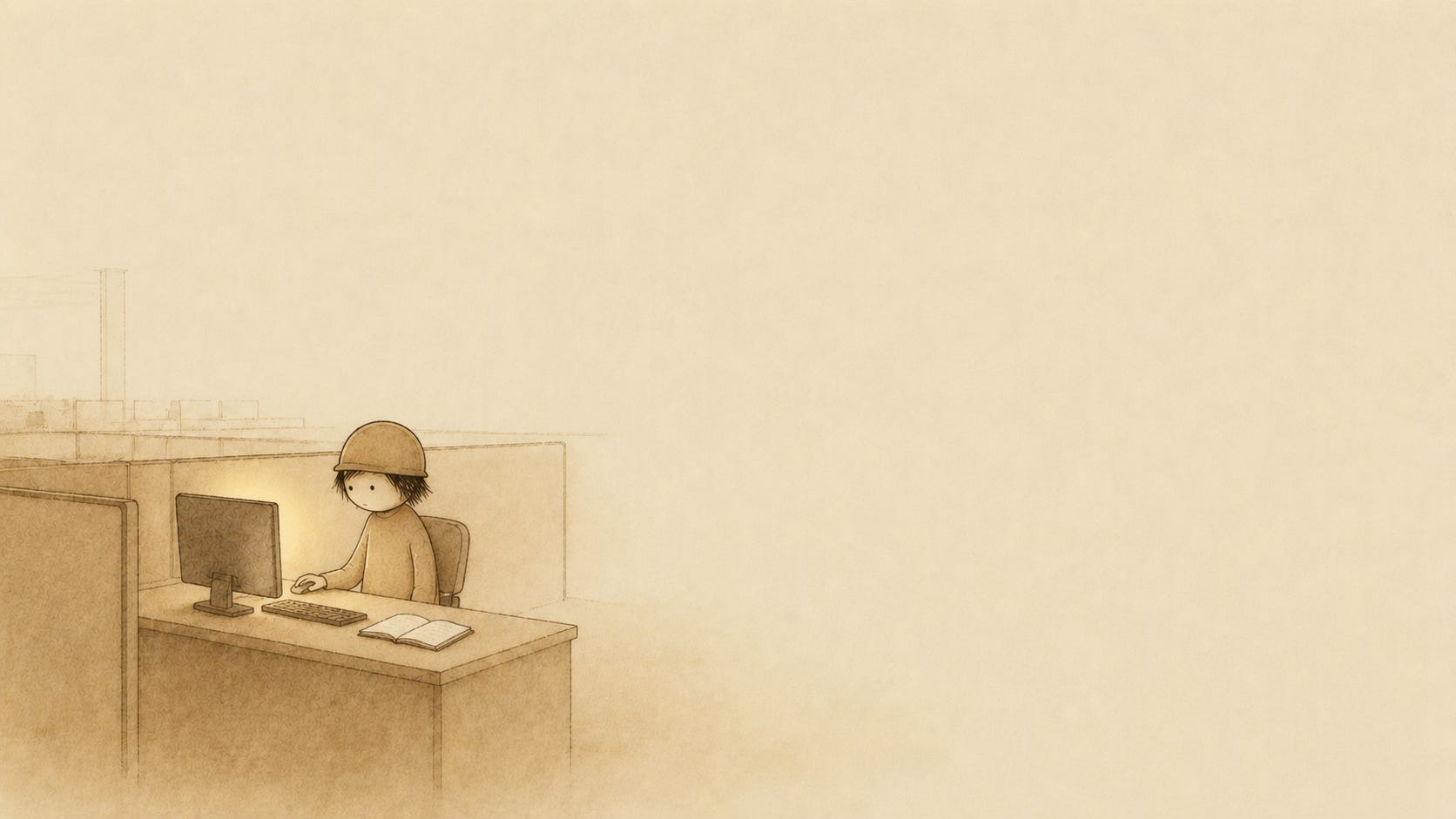
She had learned, without anyone telling her, to move her mouse while she thought. A slow drift across the screen, no destination. Just motion. Just enough to keep the green dot lit.
The instinct had grown over months. Not a decision, an adjustment, the way a person starts taking a different route home after one difficult morning and eventually stops remembering the original way. She hadn’t noticed it developing. Then one afternoon her manager stood at her desk and said, not unkindly, that her screen time report showed some gaps. She tried to explain: the pause before a hard message, the few minutes of sitting with a safety flag before deciding how to escalate. He had nodded. The nod that meant he understood and the system didn’t.
After that, the mouse moved.
This is performed presence: the cursor drifting toward nothing in particular while the mind is somewhere the tracking software cannot reach.
The morning the incident log came through she was forty minutes into a shift that had already asked too much. Three active monitoring streams. A delayed handover from the overnight team. And now this: a pattern in the data that was almost certainly nothing and might not be.
She pulled up the relevant files and read the first page. Stopped.
There is a particular kind of thinking that requires the body to be still. Not passive, still. Holding several things in tension at once, knowing any movement breaks the thread. She had been doing this work long enough to trust it.
She did not move her mouse.
For eleven minutes she sat with the possibility that the pattern was real. Ran it forward. Ran it back. Thought about who would be on-site in six hours and what they would not know. Thought about the last time she had sent an alert that turned out to be nothing, and the careful way people had thanked her for her caution, which was not quite the same as thanking her for being right.
Her manager’s shadow crossed the glass at minute eleven.
He did not come in. He looked at her screen, at the stillness of it, and moved on. But she had seen what he had checked.
She sent the alert.
Later, reviewing the shift report, she saw her eleven minutes logged as idle time. The same category the system used for screen-saver mode and lunch and the two minutes it took to refill a glass of water. A 2025 review of thirty-nine studies, published in the Scandinavian Journal of Work, Environment and Health, found that a survey of 27,250 workers across the European Union linked each increase in monitoring intensity to a 21 percent rise in workplace stress, and a 16 percent rise in health issues.
The cursor blinked. The alert had been received and acknowledged. The next shift was four hours away. The gap in the data was still there, or it wasn’t, and the system had no record of what had kept it from being missed.
These reflections are based on my own observations and learnings across industries. They do not reference any specific company, organisation, or individual.