Dust
He spent years making countertops for other people's kitchens. Nobody told him what he was breathing.

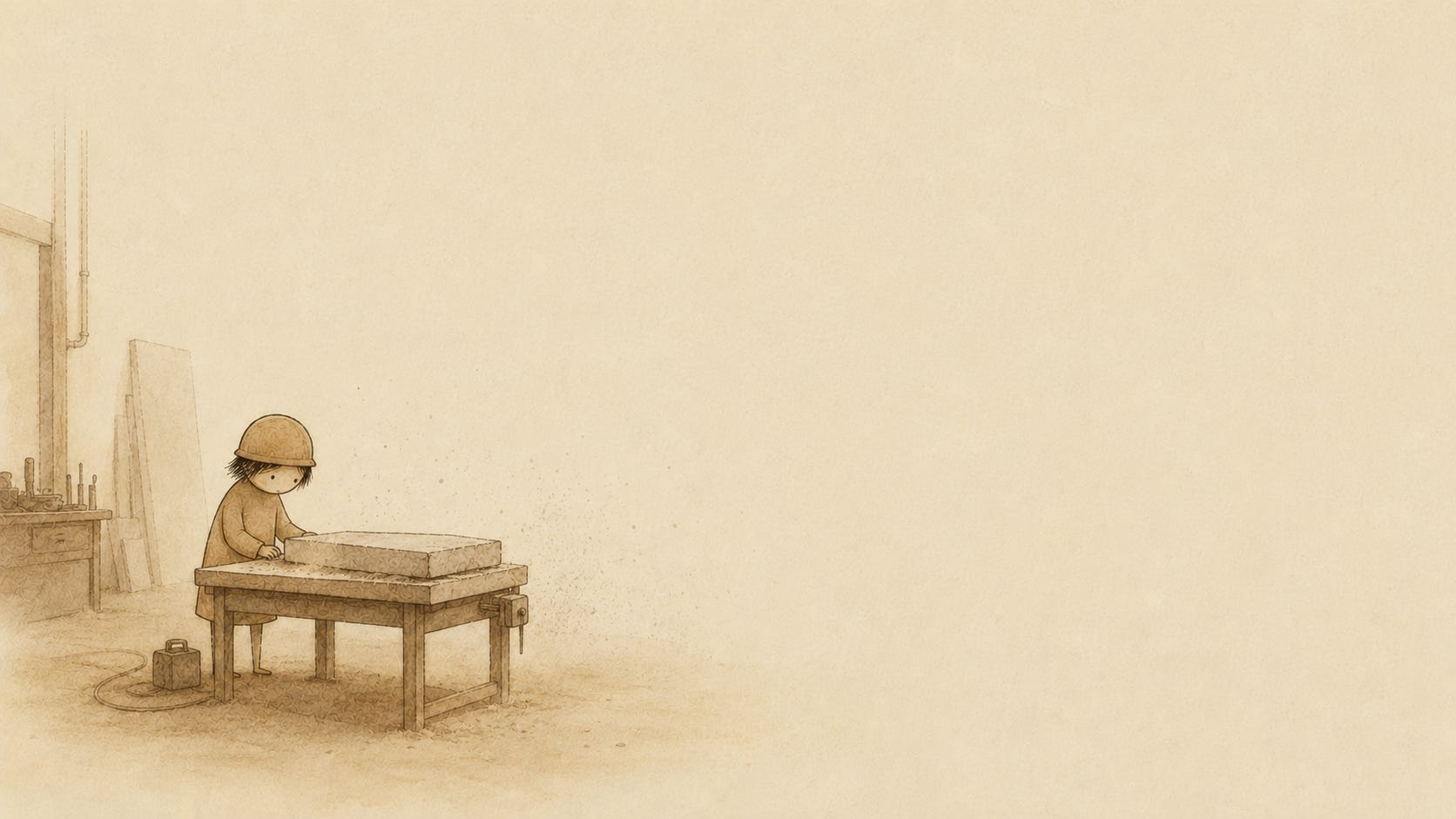
The dust didn’t look like much. It rose from the saw and settled on his arms, his shirt, the floor of the shop. He swept it up at the end of the day. He had swept up stone dust his whole working life.
What he noticed was the smell. When you cut natural stone, the dust smells like wet earth. Engineered stone smells like burnt plastic, a faint chemical note he could never quite place. He noticed it and moved on.
Nobody gave him a name for what the difference meant.
Engineered stone is made of crushed quartz bound with resin and pigments. It can contain more than ninety percent crystalline silica, more than double the silica content of granite, more than eighteen times that of marble. When it is cut, polished, or shaped, it releases particles so small they pass through standard respirators and lodge deep in the tissue of the lungs.
The manufacturers knew the silica content of their product.
What never reached the man holding the saw was what that meant for a body, every day, over years. He wore a mask. He used the wet saw when the protocol required it. He followed the instructions he had been given. He simply had not been given the right ones.
Accelerated silicosis is what physicians began calling what they were seeing in fabrication shops. Traditional silicosis takes decades: miners and sandblasters breathing silica dust for thirty years, developing disease in their fifties and sixties. The engineered stone version was appearing in workers in their thirties. Some had been exposed for only a few years. The lungs harden, scar tissue builds, ordinary breath becomes effort, then work, then impossible. There is no medication. There is no reversal. For those whose disease progresses far enough, the only option is a lung transplant that redraws what a life can contain.
A study published in 2025 in a leading respiratory medicine journal described an epidemic. California alone had documented over five hundred confirmed cases and twenty-nine deaths by early 2026. The researchers called it urgent and entirely preventable. Australia had already banned the material the previous year. Most affected workers were men in their thirties and forties. Many did not know what silicosis meant when their doctor named it.
That detail appears in account after account. The diagnosis arrived before the vocabulary did.
The countertop he made is in someone’s kitchen. Durable. Heat resistant. The colour they chose.
He is waiting.
These reflections are based on my own observations and learnings across industries. They do not reference any specific company, organisation, or individual.